





Blog
How to Keep Your Boat or Yacht’s Fresh Water Tank Clean: Preventing Biofilm, Bacteria and Odours

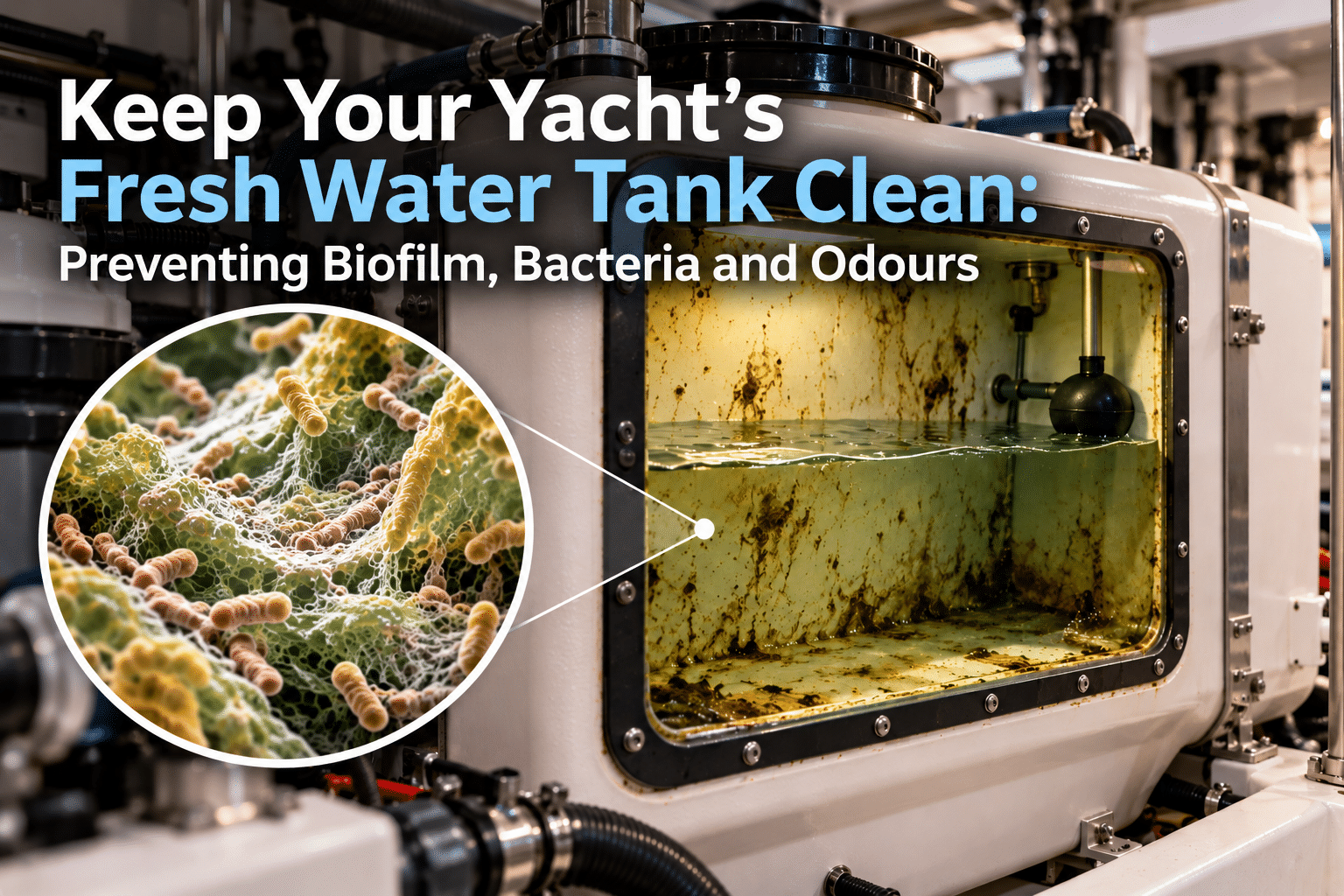
Fresh water is one of those onboard systems most of us take for granted, right up until something goes wrong.
You turn on a tap and expect clean water to come out. On a modern yacht, though, a lot happens before that water reaches the tap. A watermaker may have produced it from seawater. There may be sediment and carbon filters, UV sterilization, a dedicated drinking water filter or point of use purification somewhere along the line.
One part of the system still gets overlooked surprisingly often. The fresh water tank itself.
Producing or taking on clean water is only the beginning. Once water enters the tank it can sit there for days, sometimes much longer. Warm temperatures, long stretches of low use and contamination inside the tank or pipework all affect water quality during storage. One of the biggest culprits is biofilm, the layer of microorganisms that attach themselves to internal surfaces inside tanks, hoses and plumbing.
This is why good yacht water treatment should consider the whole journey from source to tank to tap, rather than leaning on a watermaker or a final filter to solve every problem.
In this guide we look at why yacht fresh water tanks develop bacteria, biofilm and unpleasant odors, how to clean and maintain the system, and where chlorine dioxide treatments such as Biotab7 fit into a preventative maintenance program.
Looking beyond the fresh water tank? Here, we’re focusing specifically on what happens to fresh water during storage and how to manage bacteria, biofilm and tank hygiene. For whole-yacht hygiene: including water systems, mould, HVAC, surfaces and odour control – read our Complete Guide to Marine Disinfection on Yachts.
Quick Answer: How Do You Keep a Yacht Fresh Water Tank Clean?
Keeping a yacht’s fresh water tank clean takes more than putting clean water into it. Water quality can deteriorate in storage, especially when water sits still for long periods or when tanks and pipework already harbor microbial growth.
The key points:
- Clean water entering the tank will not necessarily stay that way.
- Biofilm develops on tank walls, hoses, fittings and pipework.
- Warm conditions and stagnant water increase the risk of microbial growth.
- A watermaker treats incoming seawater. It does not clean the tank.
- Downstream filtration does not physically clean tank walls.
- UV sterilization only treats the water passing through the unit.
- Fresh water maintenance should cover the tank and the distribution system.
- Biotab7 generates chlorine dioxide when activated in water and can be used, following the product instructions, as part of an onboard treatment program.
- Correct dosage depends on the application, the weight of the tablets and the volume of water being treated.
The simple rule is this. Don’t only think about how clean the water is when it enters the tank. Think about what happens to it while it’s stored there.
Why Does Fresh Water Go Bad in a Yacht’s Water Tank?
Fresh water can deteriorate after entering the tank because storage creates very different conditions from those when the water was produced or supplied. Stagnation, warm temperatures and microbial contamination all play a part.
The distinction matters more than it might first appear. A yacht may produce fresh water through a reverse osmosis watermaker, take potable water on at a marina, or use a mix of the two. The water going into the tank may be perfectly fine. The tank itself, however, is not a sterile environment.
Water can sit inside for long stretches, particularly on a boat that’s used intermittently. From there it travels through pumps, hoses, fittings and sometimes long runs of pipework before it reaches an outlet.
Common contributing problems include long storage periods, warm ambient temperatures, low water turnover, contamination introduced while filling, existing deposits inside tanks or pipework, microorganisms attached to internal surfaces, biofilm in hoses and plumbing, and stagnant water in seldom used outlets.
The Biotab7 information supplied to Yacht-Mate specifically identifies warm temperatures, stagnation and tank surfaces as factors linked to microbial growth and biofilm in stored water.
So when investigating poor water quality onboard, don’t just ask where the water came from. Ask what has happened to it since it came aboard.
What Is Biofilm in a Yacht Fresh Water Tank?
Biofilm is a layer of microorganisms attached to a surface. In a yacht’s fresh water system it can develop on the inside of tanks, hoses, fittings and pipework, and it’s one of the main reasons tank maintenance is more complicated than draining old water and refilling.
Microorganisms don’t necessarily stay suspended in the water. They attach to surfaces and form communities wrapped in a protective matrix. That attached layer is the biofilm. Within a fresh water system it may develop on tank walls, hoses, pipes, fittings, pumps and the awkward, hard to reach parts of the distribution system.
Once biofilm is established, changing the water alone doesn’t deal with what’s left clinging to the surfaces. That’s why a yacht can be flushed and refilled, only for the unpleasant taste or smell to come back a few days later.
The water is only part of the system. The condition of the tank and plumbing matters just as much.
What Causes Bacteria and Biofilm in Yacht Fresh Water Tanks?
Bacteria and biofilm develop when microorganisms enter the system and find conditions that let them persist and grow. Warm temperatures, stagnation and low use sections of the pipework are the usual suspects onboard.
There’s rarely one single cause. Usually several factors overlap.
Warm temperatures. Yachts often operate in the Mediterranean, Caribbean, Florida or the Bahamas, where higher temperatures favor microbial activity. Fresh water hygiene becomes especially important in these climates.
Stagnant water. A busy charter yacht getting through large volumes of water every day has a very different operating pattern from a boat sitting alongside for weeks. Where water sits still, parts of the system become stagnant.
Tank and plumbing surfaces. Bacteria aren’t limited to the water itself. Internal surfaces give microorganisms somewhere to attach and biofilm somewhere to form.
Filling procedures. Fill hoses, deck fills and connections are part of the hygiene chain too, and they should be kept clean and handled properly.
Seldom used outlets. Guest cabins, deck showers and other occasionally used taps are easy to forget. Yet water sitting in a little used branch of pipework can stay stagnant even while the rest of the system is in daily use.
Why Does the Fresh Water on My Yacht Smell or Taste Bad?
Unpleasant taste or odor can come from stagnant water, microbial activity, contamination inside the tank or plumbing, or other problems in the system. Recurring odors should be investigated rather than masked.
A musty or stale smell is usually what first gets an owner or crew member’s attention, and the instinctive reaction is to change a filter. Sometimes that helps, particularly with taste. If the smell keeps coming back, though, the source is probably further upstream in the tank or the pipework.
If a yacht has been unused for several weeks in warm weather, for instance, swapping the drinking water filter won’t address the stagnant water sitting elsewhere in the system. A recurring problem deserves a proper investigation.
It’s also worth remembering that water doesn’t have to look dirty to have a water quality problem. Where the microbiological safety of the supply is in doubt, appropriate testing should be considered rather than relying on appearance, taste or smell alone.
Can a Watermaker Prevent Bacteria and Biofilm in the Fresh Water Tank?
No. A watermaker produces fresh water, but it doesn’t clean or disinfect the storage tank once that water has entered it. Tank hygiene needs to be managed separately.
It helps to think of the system as a journey, from the sea to the watermaker, then into the fresh water tank, through the distribution system and out at the tap. The watermaker operates at the very start of that journey. The tank comes after it.
A reverse osmosis watermaker can be working perfectly while the storage and distribution side of the system still needs cleaning or disinfection. This isn’t a flaw in reverse osmosis. Cleaning the tank simply isn’t the watermaker’s job.
The same logic applies when taking potable water from shore. Water that was fine when it was supplied says nothing about the condition of the yacht’s storage system.
Does a Water Filter Keep a Yacht’s Fresh Water Tank Clean?
No. A filter installed downstream of the tank treats the water passing through it. It doesn’t physically clean the internal surfaces of the tank.
This distinction matters because “water filter” can mean several different things onboard. A yacht might have sediment filtration, activated carbon, watermaker pre-filters, reverse osmosis membranes, dedicated drinking water filters, UV treatment or some combination of these, each doing a different job.
An activated carbon filter, for example, can improve taste and odor at the point of use. It isn’t traveling backwards through the plumbing to clean the tank walls. Good yacht water management is about using the right technology for the right job.
Does UV Sterilization Keep a Yacht’s Fresh Water Tank Clean?
Not on its own. A UV sterilizer treats water as it passes through the chamber. It doesn’t clean the internal surfaces of the tank upstream.
UV can be a genuinely useful part of an onboard water treatment system, but location matters. The unit treats the water flowing through it. It doesn’t remove deposits or biofilm from the tank, and it doesn’t clean the plumbing leading to it.
Asking whether UV “works” rather misses the point. The better question is where the unit sits in the system and what it’s actually treating. UV, filtration and tank maintenance can all be part of the same strategy. They simply do different jobs.
How Do You Know If a Yacht Fresh Water Tank Needs Cleaning?
Unusual taste, persistent odors, long periods of inactivity and recurring water quality problems all suggest the tank and distribution system need attention.
Warning signs include musty or stale smelling water, an odd taste, quality that deteriorates after the boat has been idle, odors that return even after flushing, visible deposits where the tank can be inspected, and problems that reappear soon after changing filters.
Even so, preventative maintenance beats waiting for something to smell wrong. If a yacht has been laid up, had plumbing work done, or gone a long stretch without normal water turnover, the fresh water system deserves attention before normal service resumes.
How Do You Clean and Disinfect a Yacht Fresh Water Tank?
Cleaning and disinfecting a fresh water tank usually means addressing both the tank and the connected distribution system. The exact procedure depends on the vessel, the condition of the tank and the treatment being used.
It also helps to separate three things that often get lumped together: physical cleaning, disinfection and ongoing maintenance. They’re related, but they aren’t the same job. If a tank contains physical deposits or heavy contamination, adding a maintenance treatment isn’t a substitute for proper cleaning.
Depending on the system and its condition, the process may involve:
- Inspecting the tank where access allows.
- Removing physical contamination where necessary.
- Draining or flushing the system as appropriate.
- Preparing an approved treatment at the correct concentration.
- Introducing it into the tank.
- Circulating treated water through the pipework and outlets where required.
- Allowing the specified contact time.
- Flushing or returning the system to service according to the treatment instructions.
- Servicing or replacing filters where necessary.
- Setting up an ongoing preventative routine.
Never guess chemical concentrations, and never mix water treatment products unless the manufacturers specifically state they’re compatible.
How Do You Remove Biofilm From a Yacht Fresh Water Tank?
Established biofilm is a surface contamination problem, not simply a case of dirty water. Dealing with it usually means cleaning and disinfecting both the tank and the connected plumbing.
Picture emptying a dirty glass, refilling it with clean water and assuming the glass is now clean. A fresh water system presents the same problem. If microbial material remains attached to the tank or pipe surfaces, replacing the water doesn’t address the source.
Where access allows, physical inspection and cleaning of the tank can form part of the process. Where access is limited, which is common on yachts, appropriate chemical treatment may be needed, following the manufacturer’s instructions.
The goal isn’t just to swap old water for new. It’s to treat the system that carries and stores the water.
Should You Empty a Yacht’s Fresh Water Tank When the Boat Is Not Being Used?
There’s no single rule that suits every yacht. The right approach depends on the vessel, the tank design, the length of inactivity and manufacturer recommendations. Extended stagnation, though, should always feature in the maintenance plan.
A yacht in daily use is a very different proposition from one sitting in a marina for several months. Before returning a boat to service after a long idle period, consider the condition of the tanks, pipework, pumps, filters, watermaker, UV equipment, hot water system, drinking water systems and every outlet.
And don’t assume that running a tap for a few seconds means the whole system has been refreshed.
What Is Chlorine Dioxide and How Is It Used in Yacht Water Systems?
Chlorine dioxide, or ClO2, is an oxidizing agent used in water treatment and disinfection. Biotab7 generates chlorine dioxide when its tablets are activated in water.
Despite the name, chlorine dioxide isn’t another word for household bleach, which is based on sodium hypochlorite. They’re different chemical compounds.
For onboard use, the question isn’t which chemical sounds stronger. It’s choosing an appropriate treatment for the application and using it correctly. That means considering what’s being treated, the water volume, the required concentration, contact time, system condition, the product instructions and, where relevant, potable water requirements. Treatment chemistry should always be used according to the manufacturer’s directions.
Can You Use Biotab7 in a Yacht Fresh Water Tank?
Biotab7 can be used for specified water treatment applications according to the product instructions, and it generates chlorine dioxide when activated in water.
For owners and crew, the tablet format has a practical advantage. Treatment can be prepared when it’s needed, without storing large containers of pre-mixed liquid. Biotab7’s product information describes applications that include fresh water tanks and lines, with chlorine dioxide used to help control microbial growth and biofilm.
That said, Biotab7 isn’t a replacement for maintaining the rest of the system. Good water hygiene still includes correct watermaker maintenance, tank inspection, sensible water turnover, filter replacement, pipework maintenance, outlet flushing, appropriate testing and correct treatment procedures.
Think of Biotab7 as one part of a tank to tap water management process, not the whole answer.
How Do You Use Biotab7 in a Yacht Fresh Water Tank?
The correct number of Biotab7 tablets depends on the weight of the tablets, the volume of water and what you’re trying to achieve, so establish the tank capacity before deciding how much product you need.
This is an area where guesswork is particularly unhelpful. Treating a small boat tank is a different exercise from treating a large yacht carrying several thousand liters, and a one time disinfection shouldn’t automatically be assumed to use the same concentration as ongoing maintenance.
Start by establishing how much water you’re treating, what the treatment is meant to achieve, which Biotab7 product is appropriate, what concentration the product guidance specifies, what activation and contact time is required, and whether the system needs circulating or flushing afterwards. Then follow the product instructions.
Don’t estimate the number of tablets from the physical size of the yacht. The relevant figure is the volume of water being treated and the intended application. If you’re unsure, speak to Yacht-Mate before treating the system.
Biotab7 vs Bleach: Which Is Used for Yacht Fresh Water Tank Treatment?
Chlorine dioxide treatments and sodium hypochlorite both turn up in water system sanitation, but they’re different chemistries and shouldn’t be treated as interchangeable.
Bleach has been used for fresh water system sanitation for many years. However, bleach is highly corrosive, has a limited shelf life, and parasites are resistant to chlorine disinfection. “Just add some bleach” isn’t a properly controlled maintenance procedure, either. Concentration matters. Contact time matters. The formulation, the tank and the system all matter, and whether the water is intended for potable use matters most of all.
Biotab7 generates chlorine dioxide when activated in water. When comparing approaches, weigh up the intended application, required concentration, contact time, tank volume, potable water suitability, material compatibility, storage and handling, and the manufacturer’s instructions.
The right question isn’t which chemical is strongest. It’s which treatment suits this system, and what’s the correct procedure for using it.
How Often Should You Clean or Treat a Yacht Fresh Water Tank?
There’s no single maintenance interval that suits every yacht. Usage, water turnover, climate, tank condition, water source and periods of inactivity all shape how the system should be maintained.
Consider two very different boats. One runs a busy charter program all summer, making and consuming large volumes of water every day. The other is privately owned and may sit alongside for weeks between trips. Their water systems aren’t living through the same conditions.
Rather than relying purely on a calendar, consider how quickly stored water is being used, whether the yacht has been inactive, where the last fill came from, whether you’re operating in a warm climate, when the tank was last inspected, when the system was last disinfected, whether filters have been maintained, whether taste or odor problems keep coming back, and whether any plumbing work has been done recently.
Preventative maintenance is far easier than waiting for a badly contaminated system to announce itself through the galley tap.
Do You Need to Disinfect the Fresh Water Pipes as Well as the Tank?
Yes. The distribution system should be part of any sanitizing routine, because biofilm and stagnant water aren’t confined to the tank.
This gets overlooked easily. Water leaves the tank and travels through pumps, accumulators, hoses, pipework, manifolds, water heaters, fixtures, taps and showers. Some branches are used constantly. Others barely at all. A guest cabin left empty for several weeks may hold water that has been sitting in its pipework the entire time, even while the galley and crew areas see normal turnover.
That’s why professional marine water guidance recommends paying attention to seldom used taps, showers and outlets when managing stagnation and biofilm. Think tank to tap, not just the tank.
How Can You Prevent Bacteria and Biofilm Coming Back?
Prevention comes from looking after the whole system, rather than repeatedly reacting to bad taste or smell after it appears.
A solid preventative approach includes maintaining reasonable water turnover, avoiding unnecessary stagnation, keeping filling equipment clean, inspecting tanks where practical, following an appropriate sanitation program, maintaining the watermaker correctly, changing filters when required, keeping UV equipment serviced, flushing seldom used outlets, using treatment products according to their instructions, and investigating recurring problems rather than masking them.
The objective isn’t to keep adding chemicals to compensate for poor maintenance. It’s to create a well managed system in which production, storage, distribution and final treatment all work together.
Yacht Fresh Water Tank Maintenance Checklist
Fresh water maintenance doesn’t need to be complicated, but it does need to be consistent.
During normal operation, monitor water quality, keep an eye on turnover and maintain filtration and treatment equipment to the manufacturer’s schedule. When filling from shore, consider the quality of the source and keep hoses, fittings and deck fills clean.
After extended inactivity, assess stagnant water, tanks, pipework, filters and outlets before returning the system to service. After plumbing or tank work, follow an appropriate recommissioning and sanitation procedure.
When taste or odor changes, investigate the source instead of assuming another filter will fix it. And when using Biotab7 or another treatment, establish the volume being treated, select the correct application and follow the specified concentration, activation and contact time instructions.
Frequently Asked Questions About Yacht Fresh Water Tanks
Can bacteria grow in a yacht fresh water tank?
Yes. Fresh water systems can support microbial growth, particularly where warm temperatures and stagnation occur. Microorganisms can also attach to tank and plumbing surfaces and form biofilm.
What is biofilm in a yacht fresh water tank?
Biofilm is a layer of microorganisms attached to a surface. In yacht fresh water systems it develops on tank walls, hoses, fittings and pipework.
Why does my yacht’s fresh water smell after the boat has been sitting?
Stagnant water and microbial activity are among the most likely causes. If an odor returns after flushing or changing filters, the tank and distribution system should also be investigated.
Can a watermaker stop bacteria growing in the fresh water tank?
A watermaker produces fresh water but doesn’t clean the tank after that water enters storage. Tank and distribution system hygiene need to be managed separately.
Does UV kill bacteria in a yacht water tank?
A UV sterilizer treats water as it passes through the chamber. It doesn’t disinfect the internal surfaces of the tank upstream.
Will changing my water filter clean the fresh water tank?
No. A downstream filter treats the water passing through it but doesn’t physically clean the internal tank surfaces or the upstream plumbing.
How do you get rid of biofilm in a yacht water tank?
Biofilm is contamination attached to system surfaces, so it needs treating as such. Depending on the condition and accessibility of the system, that may involve physical cleaning, appropriate chemical disinfection and treatment of the connected pipework.
Can Biotab7 be used in yacht fresh water systems?
Biotab7 generates chlorine dioxide when activated in water and has specified water treatment applications. The appropriate product should be selected and used according to its instructions for the intended application.
How many Biotab7 tablets do I need for my yacht?
The number depends on the weight of the Biotab7 tablets, the volume of water and the intended treatment. Establish the tank or system volume first and follow the dosing instructions rather than estimating.
Is chlorine dioxide the same as bleach?
No. Chlorine dioxide (ClO2) and sodium hypochlorite, the active ingredient in household bleach, are different chemical compounds.
Do yacht fresh water pipes need cleaning too?
Yes. The distribution system should be included in any fresh water hygiene plan, because stagnant water and biofilm can also occur in hoses, pipes and seldom used outlets.
How often should a yacht fresh water tank be cleaned?
There’s no universal interval. Usage, climate, water source, system condition and periods of inactivity should all be considered alongside the vessel and equipment manufacturers’ recommendations.
Keeping Yacht Water Clean From Tank to Tap
It’s easy to focus on the equipment we can see. The watermaker. The filters. The UV sterilizer. The drinking water system.
Good water quality onboard depends just as much on what happens between those pieces of equipment, though. The full journey runs from the source, through production and treatment, into storage, then through distribution and final treatment before it reaches the tap. The fresh water tank sits right in the middle of all of it.
If clean water enters a tank and is then left stagnant in a poorly maintained system, relying on a final filter to sort things out isn’t much of a strategy. A preventative approach works better. Know where your water comes from. Understand how long it’s being stored. Maintain the tank and the distribution system. Service the watermaker, filters and UV equipment properly. Flush the outlets that rarely get used. And chase down recurring taste or odor issues instead of masking them.
Where a treatment such as Biotab7 forms part of the maintenance program, use the appropriate product at the correct concentration and according to its specified instructions.
Producing clean water onboard is only the first part of the job. Keeping it clean all the way from tank to tap is what completes the system.
Need Help With Biotab7 or Your Yacht’s Fresh Water System?
Yacht-Mate specializes in marine water treatment, including watermakers, filtration, UV sterilization, drinking water systems and onboard water treatment.
If you’re unsure how much Biotab7 product is needed for your system, or where disinfection should fit within your existing setup, contact the Yacht-Mate team for advice.
Related Products
Yacht-Mate supplies BioTab7 tablets in different sizes and pack quantities, allowing the appropriate product to be selected according to the treatment application and volume of water being treated.