





Blog
How Do Boats and Yachts make Fresh Water Onboard?

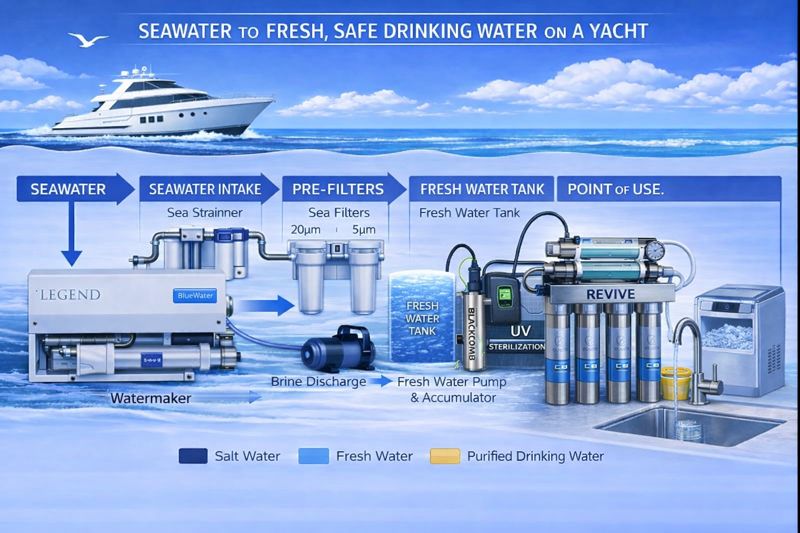
A Complete Guide to Fresh Drinking Water, Desalination Systems, and Watermakers for Boats
Fresh water is a vital resource on any boat, yacht, sailboat, or large ship. Whether you are planning long journeys, months at sea, or short coastal trips, understanding how yachts get fresh water is essential for safety, comfort, personal hygiene, and cooking.
But how does water go from seawater to fresh drinking water on board a yacht?
In this in-depth guide, we explore every way boats and yachts get fresh water, from dockside hoses and rainwater collection to advanced reverse osmosis desalination systems. We break down each technical step so you can understand how seawater is converted into potable water, how it is stored in water tanks, and how it is delivered safely to taps, showers, and ice makers.
Why Fresh Water Is Essential on Boats and Yachts
Fresh water on board is essential for:
- Drinking water
- Cooking and food preparation
- Personal hygiene (showers, brushing teeth)
- Sanitary systems
- Cleaning
- Emergency situations
Unlike homes on land, boats have limited access to local water once they leave the dock. This makes access to fresh water one of the most critical considerations in yacht design and operation.
A reliable freshwater supply is not optional — it is a vital resource.
Main Ways That Boats and Yachts Get Fresh Water
There are several ways that yachts get fresh water, depending on the boat’s size, usage, and cruising plans.
1. Taking On Water at the Dock
Most boats start their journey by filling their water storage tanks at a marina.
- Water is supplied through a hose
- Tanks are filled via a deck faucet
- Water quality depends on the local water supply
This method is common but limits how long you can stay at sea.
2. Bottled Water On Board
Some boats rely partially on bottled water for drinking.
- Useful for emergencies
- Takes up storage space
- Creates plastic waste
- Not practical for long journeys
3. Rainwater Collection
Some yachts collect rainwater:
- Deck runoff directed to a holding tank
- Requires filtration and purification
- Not reliable in dry climates
Rainwater is usually a supplement, not a primary source.
4. Onboard Desalination Systems (Watermakers)
For long journeys and offshore cruising, most yachts rely on watermakers.
A watermaker is an onboard desalination system that converts seawater into fresh water using reverse osmosis (RO).
This is the most reliable and independent way to produce fresh water at sea.
What Is a Watermaker and How Does It Work?
A watermaker for boats is an onboard desalination system designed to convert seawater into fresh, potable water that is safe to drink while at sea.
Watermakers work by drawing in seawater, removing salt and impurities, and producing clean fresh water using reverse osmosis technology. Modern reverse osmosis watermakers are specifically engineered for marine environments, making them reliable for yachts, sailboats, and long-distance cruising.
This same reverse osmosis process is also used in:
- Municipal water treatment systems
- Large-scale industrial desalination plants
- Emergency water purification units
Because of their efficiency and reliability, watermakers for boats and yachts are now considered essential equipment for vessels spending extended time away from the dock.
Step-by-Step: How Seawater Is Converted Into Fresh Drinking Water
Here is the complete water system flow found on most yachts:
Seawater → Seawater Intake → Filtration → Reverse Osmosis → Fresh Water Tank → Pump & Accumulator → UV Light → Carbon Filter → Drinking Water Tap / Ice Maker
Each step plays a critical role in water quality and safety.
Seawater Intake: Where the Water Comes From
The process begins with seawater intake.
Key Components:
- Through-hull fitting
- Seacock (safety valve)
- Sea strainer
The sea strainer removes large debris such as:
- Seaweed
- Sand
- Shell fragments
This step protects the entire water treatment system.
Filtration Systems: Protecting the Desalination Process
Before seawater reaches the reverse osmosis membranes, it passes through dedicated marine filtration systems designed to protect the desalination process and maintain water quality onboard.
These pre-filters for boats remove contaminants that could damage the RO system or reduce its efficiency. On most yachts, filtration is carried out in multiple stages to progressively remove particles from the seawater.
Typical filtration stages include:
- 20-micron filter – removes larger sediment and debris
- 5-micron filter – captures finer particles before reverse osmosis
Together, these filters remove:
- Sediment
- Organic matter
- Impurities that could foul or damage RO membranes
Using high-quality marine filters and housings is essential to prevent contamination, protect sensitive desalination equipment, and ensure consistent freshwater production while at sea.
Reverse Osmosis (RO): The Heart of Desalination
What Is Reverse Osmosis?
Reverse osmosis (RO) is a desalination process that uses high pressure to force seawater through a semi-permeable membrane, allowing fresh water to pass through while rejecting salt and other impurities.
This process removes:
- Dissolved salts
- Impurities
- Bacteria and viruses
As a result, only clean freshwater molecules are produced.
Why Reverse Osmosis Is Used on Yachts
Reverse osmosis is the preferred desalination method on yachts because it is:
- Highly efficient
- Capable of producing safe drinking water
- Effective at removing bacteria and viruses
- Able to operate continuously while at sea
This is how yachts reliably convert seawater into fresh water, even during long offshore passages.
👉 Learn more about how reverse osmosis water systems work on yachts and boats.
Brine Discharge: What Happens to the Salt?
Reverse osmosis creates two outputs:
- Fresh water (product water)
- Brine (concentrated saltwater)
The brine is safely discharged back into the sea and never enters the freshwater storage tanks.
Fresh Water Storage Tanks On Board
Once water is produced, it is stored in fresh water tanks.
Types of Water Tanks:
- Plastic (most common)
- Stainless steel
- Holding tanks in larger ships
Why Water Storage Matters:
- Provides supply when watermaker is off
- Supports emergency situations
- Balances production and consumption
Clean tanks are essential to maintain water quality.
Fresh Water Pumps and Accumulators
Water does not flow on its own — it must be pressurised.
Fresh Water Pump:
- Delivers water throughout the yacht
- Supplies taps, showers, and appliances
Accumulator Tank:
- Smooths water pressure
- Reduces pump cycling
- Improves comfort and reliability
Together, they form the freshwater distribution system.
UV and Silver Ion Water Sterilisation: Making Water Safe to Drink Onboard
To ensure fresh water is safe to drink, many yachts use water sterilisation systems as the final stage of treatment. These systems protect drinking water from bacteria, viruses, and microorganisms that may develop in tanks or plumbing over time.
UV water sterilisation works by exposing flowing water to ultraviolet light, which disrupts the DNA of microorganisms and prevents them from reproducing. This method is highly effective, chemical-free, and widely used on yachts and boats.
Silver ion water sterilisation provides an additional layer of protection by releasing trace amounts of silver ions into the water. These ions inhibit bacterial growth inside tanks and pipework, helping to maintain long-term water quality.
Many modern yachts combine UV and silver ion water sterilisation systems to ensure consistent, safe drinking water throughout the vessel.
👉 Explore marine water sterilisation systems designed for yachts and boats.
Carbon Filters: Improving Taste and Smell
Carbon filters are often installed after UV sterilisation.
They:
- Improve taste
- Remove odours
- Enhance drinking water quality
Carbon filtration is especially important for:
- Drinking water
- Ice makers
- Cooking water
Drinking Water, Showers, and Domestic Use
On most yachts, the freshwater system is intelligently divided into drinking water and domestic water lines. This separation ensures the highest water quality where it matters most, while keeping the overall system efficient and reliable.
Drinking Water Line
Water intended for consumption is treated to the highest standard before reaching the tap. It typically passes through:
- UV sterilisation, to neutralise bacteria and microorganisms
- Carbon filtration, to improve taste and remove odours
- A dedicated drinking water faucet, usually located at the galley
This final-stage treatment ensures drinking water is safe, clean, and pleasant to use.
Domestic Water Line
Water used for everyday onboard tasks follows a slightly different path. It supplies:
- Showers
- Sinks
- Cleaning and washing systems
Domestic water may bypass final taste and polishing filters, as it is not intended for ingestion. This reduces unnecessary filter use and helps conserve system capacity.
By separating drinking and domestic water lines, yachts achieve better water quality, lower maintenance requirements, and more efficient freshwater management onboard.
Many yachts further enhance this setup by installing dedicated drinking water systems at the point of use, providing additional filtration and treatment before the water reaches the tap.
Is RO Water Potable and Safe to Drink?
Yes. Reverse osmosis water is potable, drinkable, and safe.
RO water meets international drinking water standards and is often cleaner than dock water.
Minerals come from food, not water, so RO water is safe for long-term consumption.
Water on Board During Long Journeys
For long journeys and months at sea:
- Watermakers provide independence
- Freshwater supply is continuous
- Storage tanks act as a buffer
This allows yachts to remain offshore without relying on water delivery services.
Common Yacht Plumbing and Water System Layouts
Most yacht plumbing systems follow this structure:
- Seawater intake
- Filtration
- Reverse osmosis system
- Freshwater storage
- Pump & accumulator
- Purification
- Point of use
Larger ships may include redundant systems for safety.
Maintenance: Keeping Water Systems Reliable
Regular maintenance includes:
- Cleaning sea strainers
- Replacing filters
- Checking UV light bulbs
- Sanitising tanks
- Monitoring water quality
Good maintenance prevents contamination and system failure.
Emergency Situations and Water Safety
In emergency situations:
- Stored fresh water is critical
- Manual pumps may be used
- Bottled water acts as backup
Water is essential for survival at sea.
Frequently Asked Questions
How do yachts get fresh water?
Yachts get fresh water from dockside water supplies, rainwater collection, bottled water, and onboard desalination systems that use reverse osmosis to convert seawater into fresh drinking water.
How do yachts convert seawater into fresh water?
Yachts convert seawater into fresh water using reverse osmosis watermakers, which remove salt, bacteria, and impurities through high-pressure filtration.
Is water from a watermaker safe to drink?
Yes. Water produced by a watermaker is safe to drink, especially when combined with UV sterilisation and filtration systems that protect water quality inside tanks and plumbing.
How much fresh water can a yacht produce?
Fresh water production depends on the size of the watermaker, but most systems produce anywhere from tens to thousands of litres of fresh water per day.
Final Thoughts: Fresh Water Is the Foundation of Life at Sea
Fresh water is essential for life, safety, and comfort on board. Thanks to modern watermakers, desalination systems, filtration, and purification, yachts can now access safe, potable water anywhere in the world.
Understanding how water goes from seawater to drinking water empowers yacht owners and crew to:
- Improve water quality
- Prevent contamination
- Extend system life
- Cruise longer and safer
Fresh water on a yacht is no longer a limitation — it is a well-engineered system that supports modern life at sea.