





Blog
ICESEA Marine Ice Maker — Everything You Need to Know

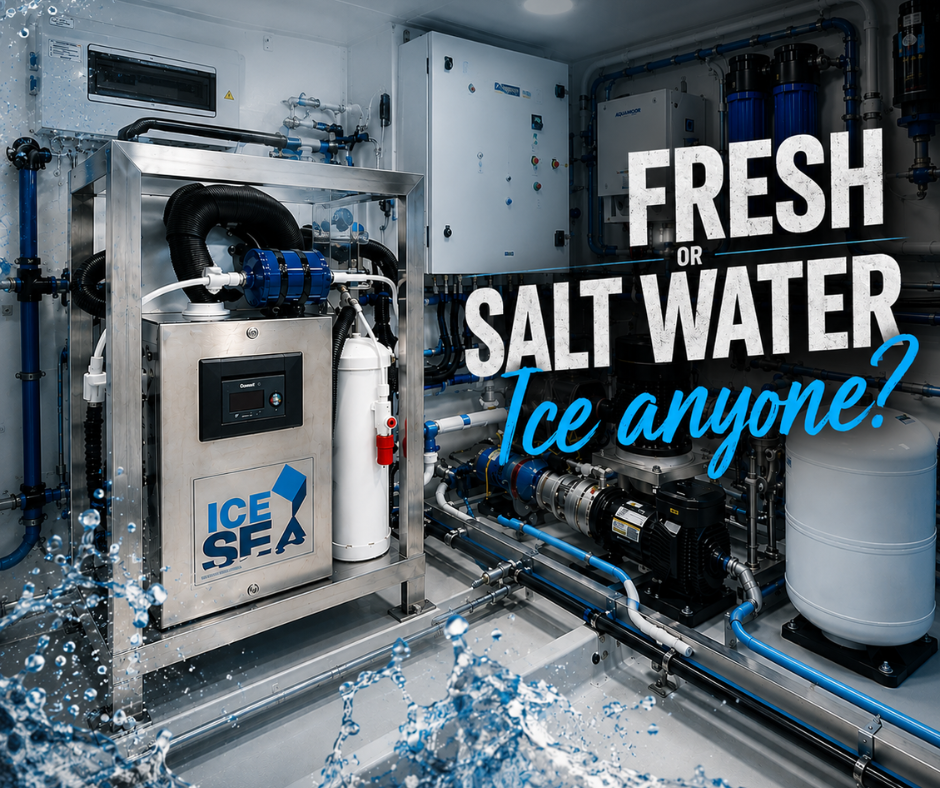
Ask any experienced captain what they wish they’d installed sooner. Watermaker, usually. Good navigation instruments. And then — almost always — a proper marine ice maker.
Ice is one of the highest-demand consumables aboard any working yacht — and most vessels depend entirely on shore supply to get it. The ICE SEA marine ice maker, available through Yacht-Mate Products in Fort Lauderdale, changes that completely. Producing up to 2,400 lbs of ice per day from either fresh water or seawater, it gives yachts, superyachts, and commercial fishing vessels full onboard ice independence. Available in self-contained models (800–1,200 lbs/day) and a split-system configuration (up to 2,400 lbs/day), all units feature stainless steel augers and evaporators built for long-term saltwater duty. Once you have an ICE SEA aboard, running out of ice becomes a problem you used to have.
Why Do Yachts Need So Much Ice — and Why Does It Always Run Out?
There’s a hierarchy of essentials when fitting out or refitting a yacht. Engines, navigation systems, safety equipment, watermaker — these get planned, budgeted, and specified early. Ice almost never does.
It’s easy to understand why. Ice feels like a provisioning decision, not an equipment decision. You buy it at the marina. You carry bags of it down the pontoon. Problem solved.
Except it isn’t. Not really.
A busy charter yacht can consume 80 to 120 lbs of ice per day without breaking a sweat. Between guest drinks service, galley food preservation, fish storage on sportfishing vessels, and the growing expectation of ice-cold towels and poolside service aboard superyachts, ice is in constant, high-volume demand. It doesn’t stop being needed at 10pm, or at anchor, or on passage, or when you’re three days out from the last marina that had any left.
The shore-ice model works fine — until it doesn’t. Until you’re anchored somewhere genuinely remote. Until the marina is out. Until you’ve done the maths and realised you’re spending thousands per season on ice alone, plus the time, labour, and indignity of hauling it down the dock in August heat.
Experienced operators know this. It’s why the marine ice maker has quietly moved from luxury item to serious working equipment aboard vessels that do meaningful time at sea. And it’s why ICE SEA, available through Yacht-Mate Products in Fort Lauderdale, has earned a reputation among captains, engineers, and refit yards as the onboard ice solution that actually works.
What Is the ICE SEA Marine Ice Maker — and How Does It Work Onboard?
ICE SEA is a purpose-built continuous-production marine ice maker. It is not a domestic machine adapted for boats, nor a commercial catering unit bolted into a bilge space. It was engineered from the ground up for the specific demands of the marine environment — saltwater compatibility, compact dimensions, stainless steel construction throughout the water-contact components, and continuous operation under the vibration, motion, and variable conditions of life at sea.
Available through Yacht-Mate Products — a Fort Lauderdale company with deep expertise in marine water treatment and onboard fluid management — ICE SEA comes in a range of models sized from 800 lbs to 2,400 lbs of daily production. There are two physical configurations: self-contained units, where every component sits in a single integrated frame, and split-system units, where the evaporator assembly and condensing unit can be installed separately to suit larger or more complex vessel layouts.
What unites every model is the core promise: continuous, autonomous ice production aboard your vessel, regardless of where you are, regardless of what the nearest marina stocks, and regardless of whether you’re drawing from your freshwater tanks or straight from the sea beneath the hull.
For full product details, specifications, and to speak with the Yacht-Mate Products team, visit the ICE SEA product page.
Can a Marine Ice Maker Really Use Seawater? Yes — Here’s How
Almost every marine ice maker on the market requires a freshwater supply. That seems reasonable — ice is frozen water, water is water — until you’re on a long passage with limited freshwater reserves and a daily ice demand of 60 lbs. Ice production and freshwater reserves are suddenly in direct competition.
ICE SEA removes that constraint entirely. Every model in the range can operate on either a fresh water supply or a direct seawater intake, switchable depending on your operational situation.
The science that makes this possible is elegant. When salt water begins to freeze, water molecules form ice crystals first — the dissolved salts are physically excluded from the crystal structure and remain concentrated in the surrounding liquid brine. ICE SEA’s auger-evaporator system is engineered to harvest those freshly formed crystals before the brine can contaminate them, producing ice that is substantially fresher than the seawater source.
It is not purified drinking water ice. But it is entirely appropriate — and widely used — for fish chilling, food preservation, beverage cooling, and every other standard onboard application.
For vessels on extended bluewater passages, in remote cruising grounds, or operating in areas where freshwater reprovisioning is uncertain, this capability is a genuine operational advantage. Your ice supply becomes, in practical terms, unlimited — as long as you’re at sea, you have a water source.
How Does ICE SEA Turn Water Into Ice Continuously at Sea?
ICE SEA uses an auger-style ice making process — sometimes called a screw-type or nugget ice system — and understanding how it works explains both the type of ice produced and why the machine is built the way it is.
Water enters a vertical stainless steel evaporator cylinder and is chilled from the outside by the refrigeration circuit. As the water contacts the cold evaporator wall, ice crystals begin to form continuously on the surface — a constant, steady process rather than the fill-and-freeze batch cycle of a conventional ice machine.
A stainless steel auger rotates slowly inside the evaporator, continuously scraping those ice crystals from the wall and pushing them upward in a spiral motion. As the ice travels up the auger, it is compressed — squeezing out residual moisture and producing dense, low-moisture nugget ice. At the top of the auger, the ice is extruded into the storage bin.
The result is a soft, chewable, highly versatile nugget ice with a large surface area relative to its volume. It surrounds whatever it’s chilling more completely than cube ice, transfers cold more efficiently, and produces less meltwater flooding. For beverage service it’s ideal. For fish chilling it’s excellent. For medical use or food display it performs exceptionally well.
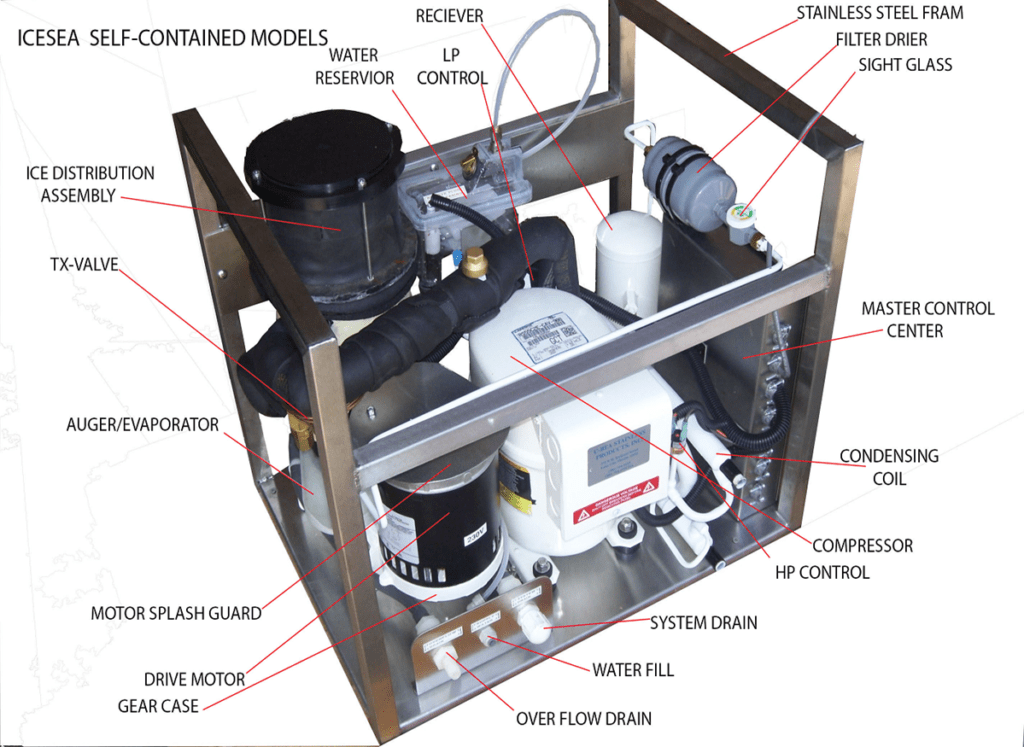
The refrigeration circuit uses R404A — a well-established HFC refrigerant with zero ozone depletion potential. In self-contained models, the compressor and condenser share the same frame as the auger assembly. In split-system models they are separated for installation flexibility.
Stainless steel throughout the water-contact components — evaporator, auger, all internal surfaces — is not an optional upgrade. In a saltwater environment, lesser alloys corrode rapidly, contaminating ice and causing premature mechanical failure. Stainless steel is the baseline specification, not a premium feature.
Self-Contained or Split-System — Which ICE SEA Model Is Right for Your Vessel?
The choice between ICE SEA’s two physical configurations shapes how the system integrates into your vessel, and it’s worth thinking through carefully before specifying.
Self-Contained Units (IC800W, IC800CW, IC1200CW)
Every component — compressor, condenser, evaporator, auger — is housed in a single integrated frame. Connection requirements are simple: water in, electrical supply, drain. The IC800 measures 22.5 × 16 × 21.5 inches and weighs 165 lbs; the IC1200CW is slightly taller at 24.25 inches and weighs 195 lbs. Both are genuinely compact for the production volumes they deliver.
The key installation consideration is ventilation. The condensing unit generates heat that must dissipate freely — the space around the unit needs adequate airflow, and ambient temperatures should not regularly exceed 40°C. A well-ventilated engine room, a dedicated equipment space with extraction ventilation, or a galley area with good air circulation all work well. A sealed, thermally loaded space does not.
Self-contained units are the right choice for most vessels under approximately 30 metres with reasonable engine room conditions.
Split-System Units (IC2400CW)
The split-system separates the evaporator/auger assembly from the condensing unit, allowing each to be positioned independently. On a large superyacht or commercial vessel — where the engine room may already be heavily loaded with heat from propulsion, generators, and air conditioning — this is a meaningful practical advantage. The condensing unit goes where there’s space and ventilation; the auger assembly goes where the ice bin is.
The IC2400CW produces up to 2,400 lbs of ice per day — 100 lbs per hour — at a combined weight of 300 lbs. At this production level it’s sized for high-demand charter operations, commercial fishing vessels, or large superyachts with serious daily ice requirements. Specific electrical and dimensional specifications are available on request from Yacht-Mate Products.
Download the Self-Contained Spec Sheet (PDF) or the Split-System Spec Sheet (PDF) for full technical details.
ICE SEA Specifications: How Much Ice Does It Actually Produce?
| Specification | IC800W / IC800CW | IC1200CW | IC2400CW (Split) |
|---|---|---|---|
| System Type | Self-Contained | Self-Contained | Split-System |
| Max Ice Production | 800 lbs/day | 1,200 lbs/day | 2,400 lbs/day |
| Hourly Production | 33 lbs/hr | 50 lbs/hr | 100 lbs/hr |
| Water Consumption | 4 gal/hr | 6.2 gal/hr | 12.4 gal/hr |
| Weight | 165 lbs | 195 lbs | 300 lbs (combined) |
| Unit Dimensions | 22.5″ × 16″ × 21.5″ | 22.5″ × 16″ × 24.25″ | Call for specs |
| Electrical — W Model | 13A @ 115V | — | — |
| Electrical — CW Model | 6.5A @ 230V | 11.3A @ 230V | Call for specs |
| Refrigerant | R404A | R404A | R404A |
| Auger & Evaporator | Stainless Steel | Stainless Steel | Stainless Steel |
| Water Source | Fresh or Salt Water | Fresh or Salt Water | Fresh or Salt Water |
| Parts Warranty | 2 Years | 2 Years | 2 Years |
| Labour Warranty | 1 Year | 1 Year | 1 Year |
| Raw Water Pump Warranty | 1 Year (manufacturer) | 1 Year (manufacturer) | 1 Year (manufacturer) |
All figures based on 24-hour cycle at 78°F ambient. Specifications subject to change without notice.
Putting the numbers in context: 800 lbs per day works out at roughly 33 lbs every hour, continuously. A standard ice bag holds 20 lbs — so the IC800 is producing the equivalent of nearly two bags of ice every hour, around the clock, without stopping. The IC2400CW produces the equivalent of five bags per hour. For a vessel that previously relied on marina ice, these numbers represent a fundamental shift in how ice is managed aboard.
Voltage selection matters: The W-model (115V) suits North American vessels and US shore power connections. The CW models (230V) are the right specification for European marinas and most superyacht electrical systems. Mediterranean operators and anyone regularly connecting to European shore power should always specify CW.
Who Needs a Marine Ice Maker? Charter Yachts, Fishing Boats, and Bluewater Cruisers
Charter Yachts and Superyachts
Ice is woven through every aspect of charter hospitality — drinks, food presentation, ice buckets, poolside service, cold towels, provisioning storage. A charter yacht that manages ice poorly is a charter yacht that gets poor reviews. ICE SEA’s continuous production means the ice bin is never empty, the chief stewardess is never rationing, and the crew isn’t making emergency ice runs at 7am before guests surface for breakfast.
Beyond the hospitality angle, there’s a pure operational efficiency argument. The time, cost, and coordination involved in sourcing, transporting, and loading shore ice across an entire charter season is substantial. ICE SEA amortises that cost against itself relatively quickly on a vessel doing serious charter work.
Sportfishing and Commercial Fishing Vessels
This is perhaps the application where ICE SEA’s capabilities are most operationally critical. Fish quality deteriorates rapidly without immediate, adequate chilling — both in terms of eating quality and food safety compliance. A fishing vessel that can produce 800 to 2,400 lbs of ice per day from seawater, with no shore dependency, is a fundamentally different operation from one that loads ice at the dock and hopes it lasts.
For bluewater sportfishing or commercial operations working days from port, the saltwater ice production capability isn’t a nice-to-have. It’s the difference between a viable operation and a compromised one.
Long-Range and Bluewater Cruising Yachts
For serious offshore cruisers — crossing oceans, spending months in remote cruising grounds, exploring regions where marina infrastructure is minimal — ICE SEA transforms ice from a scarce resource to a continuous supply. Freshwater tank management no longer needs to account for ice production. Provisioning strategy simplifies. And the quality-of-life improvement of reliable cold drinks and proper food preservation on a long passage is, according to sailors and captains who’ve made the switch, genuinely significant.
Liveaboards
The liveaboard case is quieter but equally compelling. For those who live aboard full-time, never managing shore ice — never running out mid-week, never making ice runs, never doing the mental calculation of “have we got enough for tonight?” — is one of those upgrades that quickly becomes invisible in the best possible way. You stop thinking about ice, because ice is simply always there.
How Is ICE SEA Installed on a Yacht — Space, Power, and Water Requirements
ICE SEA installation is not a complex project by yacht refit standards, but a few key considerations should shape your planning.
Space and airflow. Self-contained units need clear air circulation around the condenser — at minimum 150mm on all sides, and a route for warm air to escape the installation space. Production rates are rated at 78°F ambient; higher temperatures reduce daily output. Plan the installation location before the unit arrives.
Water supply. The unit needs a raw water connection — either from the vessel’s freshwater system or from a sea cock with appropriate strainer. For saltwater operation, ensure the sea chest and strainer are sized for continuous draw at the relevant hourly consumption rate.
Electrical supply. European and Mediterranean operators should specify CW models (230V). Confirm your electrical panel has capacity for the amperage draw, and consider a dedicated circuit — particularly if other high-load equipment shares the same supply.
Drain. ICE SEA requires a gravity drain for meltwater from the ice bin and for brine discharge during saltwater operation. Route this to a grey water sump or overboard via an appropriate sea cock.
Contact Yacht-Mate Products via the ICE SEA product page to discuss your specific vessel’s installation requirements.
How Do You Maintain a Marine Ice Maker — and How Long Will It Last?
ICE SEA is built to run — but like any piece of marine mechanical equipment, it repays consistent maintenance with long service life.
Descaling is the primary routine task. Scale build-up on the evaporator surface reduces thermal efficiency and ice production over time. A food-safe ice machine descaler every one to three months — depending on water hardness and usage intensity — keeps the evaporator clean and production figures where they should be.
Fresh water flushing after saltwater use is strongly recommended. After any period of saltwater ice production, running the water circuit through with fresh water removes concentrated brine before it can settle. Many operators make this a standard end-of-session routine — it takes minutes and meaningfully extends component life.
Refrigeration circuit servicing should be carried out by a certified marine refrigeration technician, at intervals consistent with the compressor manufacturer’s recommendations. Annual inspection is typically appropriate for moderate-duty use.
Stainless steel construction throughout the water-contact components means corrosion-related failure — the most common cause of premature ice maker failure in marine environments — is dramatically reduced compared with units using lesser materials.
It is also worth noting that raw water pump components bear the greatest exposure during saltwater operation. ICE SEA’s warranty structure reflects this, with a separate one-year warranty on raw water pumps backed by the pump manufacturer directly.
Frequently Asked Questions on the IceSea
Can the ICE SEA marine ice maker genuinely use seawater?
Yes. Every model in the ICE SEA range can draw from a seawater intake and produce clean, usable ice. The auger-evaporator process naturally excludes most dissolved salts as ice crystals form, producing ice appropriate for fish chilling, food preservation, and beverage use.
How much ice does ICE SEA produce per day?
The range spans 800 lbs per day (IC800 models) to 1,200 lbs per day (IC1200CW) in self-contained configurations, and up to 2,400 lbs per day in the IC2400CW split-system. All figures are based on a 24-hour continuous cycle at 78°F ambient temperature.
What size vessel is ICE SEA suitable for?
The self-contained IC800, at 22.5 × 16 × 21.5 inches and 165 lbs, can realistically be installed on vessels from approximately 15 metres upward with an accessible equipment space. Larger vessels typically specify the IC1200CW or IC2400CW split-system based on daily ice demand.
What type of ice does ICE SEA produce?
ICE SEA produces nugget ice — also called auger ice or chewable ice. It’s a compressed, low-moisture format with a large surface area, highly effective for rapid chilling, beverage service, food display, and fish preservation.
What are the voltage options of the Ice Sea?
The IC800W operates on 115V/13A for North American applications. The IC800CW runs on 230V/6.5A and the IC1200CW on 230V/11.3A for European and superyacht electrical systems. IC2400CW specifications are available on request.
How much water does ICE SEA consume in operation?
The IC800 series draws approximately 4 gallons per hour. The IC1200CW draws 6.2 gallons per hour. In saltwater mode, raw water draw will be higher as brine is discharged separately.
What maintenance does ICE SEA require?
Descaling every one to three months, fresh water flushing of the water circuit after saltwater use, and annual inspection of the refrigeration circuit by a certified marine refrigeration technician.
Where can I buy ICE SEA or request a quote?
ICE SEA is available through Yacht-Mate Products in Fort Lauderdale. Visit the ICE SEA product page to view specifications, download datasheet PDFs, and contact the sales team directly.
Is the ICE SEA the Right Marine Ice Maker for Your Yacht?
The best piece of yacht equipment is the kind you stop thinking about — because it just works, every day, without fuss, without running out, without a trip to the marina to sort it. ICE SEA is that kind of equipment.
It doesn’t announce itself. It sits in the engine room or equipment space, drawing water — fresh or salt, it doesn’t much care — and converting it into ice. Continuously. Through passages and anchorages and charter weeks and bluewater crossings.
For captains tired of managing shore ice logistics. For chief stewardesses who’ve run out of ice at the worst possible moment. For engineers who want a machine built properly for the marine environment. For owners who want their vessel to be genuinely self-sufficient.
View the ICE SEA marine ice maker on Yacht-Mate Products → Download Self-Contained Spec Sheet (PDF) |Download Split-System Spec Sheet (PDF)
Article by the Yacht-Mate Products editorial team. All technical specifications sourced from official ICE SEA manufacturer documentation. Last updated: June 2026.
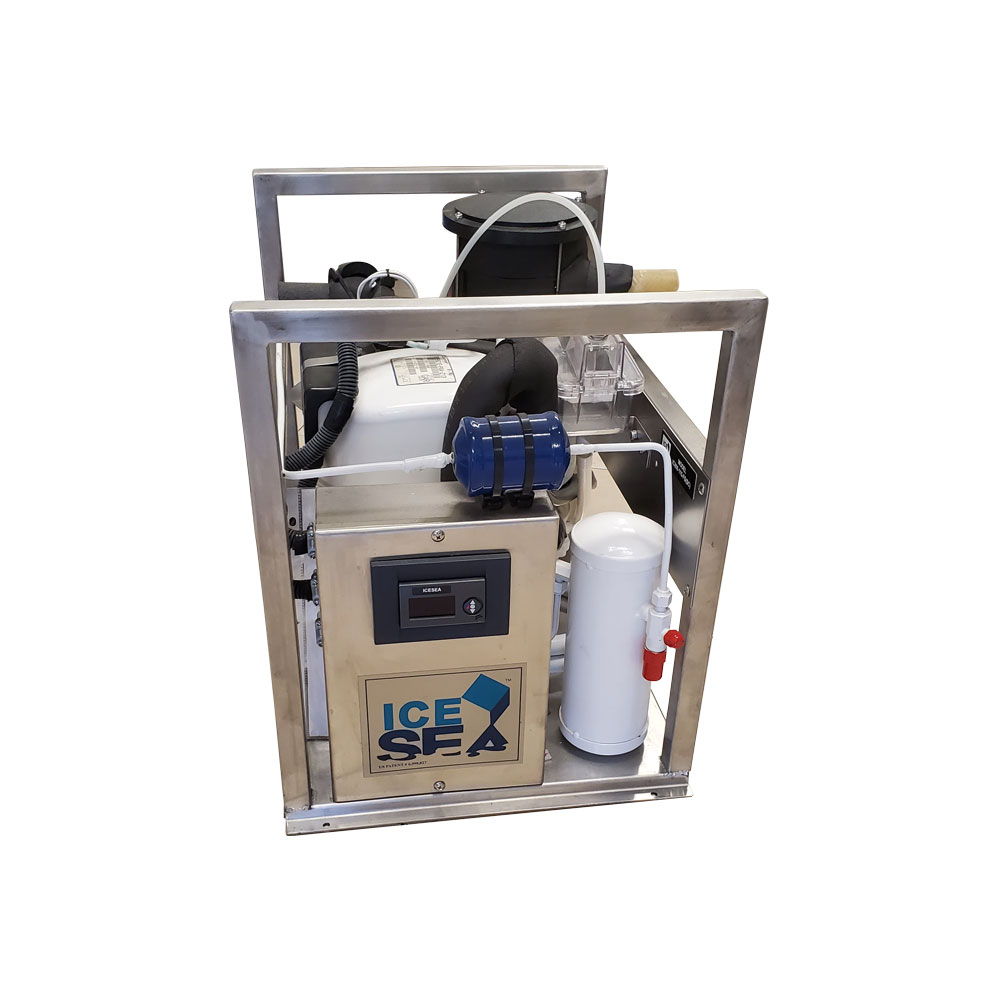
IceSea Ice Maker
The ICESEA marine ice maker delivers continuous onboard ice production from fresh water or seawater — up to 2,400 lbs per day. Purpose-built for yachts, superyachts, and commercial fishing vessels, with stainless steel auger and evaporator throughout. Self-contained models from 800 lbs/day. Split-system up to 2,400 lbs/day. Up to 66% more energy efficient than comparable marine ice makers. Starts at $21,000 for a 800 fresh at 115v.